Showing posts with label Mental Illness. Show all posts

Monday, June 26, 2017

You're Coping Well . . . Now What?


I think playing on swings is the way to be.
Mental illness, whatever your diagnosis may be, comes with its ups and downs. No one is at their lowest all the time. No one is coping well all the time, though some of us excel at coping most of the time. The yo-yo of symptom severity can make it tough to enjoy the down time when it comes. When you are coping well, and life isn't controlled by symptoms, you can sometimes forget what to do with yourself. You may also feel like the shadow of your illness is waiting to jump out at you any time. Therapists give us all these tools for dealing with being sick, but what do we do when we're not feeling sick?

It is important to be somewhat diligent about how you treat yourself mentally and physically no matter where you're at with your symptoms. Feeling great? You can either hasten a decline in your mental health or you can bolster your well-being. At the risk of sounding like your mother or your doctor, here are a few things you shouldn't do: Drink alcohol to any sort of access, do drugs, engage in self-destructive behavior, etc. Here are a few shoulds to balance it out: Eat relatively well (I say relatively because you have to splurge); exercise as much as you can, practice your coping mechanisms, etc.

Now that we've got the "nurture yourself to stay better longer" part out of the way, I want to get to the short and simple answer to our question. What should you do when you're coping well, even if you're afraid of your symptoms coming back at any moment? LIVE. Check off some shit on the bucket list. Build strong and healthy relationships by bonding with loved ones. Go to a movie theater. Visit friends. Travel. Hey, coping well might mean you still have limitations. For instance, I still have anxiety all the time, so I still don't travel far when I'm coping "well," but let's push the boundaries while we're up for it. Let's dare to have fun. Give yourself memories to help you get through the hard times. Love every second of it.

Friday, December 30, 2016

Holidays and Hospitals

Trapped in the death grip
of a mall Santa
Thanksgiving, Christmas, New Years . . . some mentally ill folks would rather skip these orgies of food, festivities and family. They're a sensory overload combined with forced family fun that can end in frantic family fighting. Panic attacks, depression, reminders of lost of loved ones and financial stress are just a few of the things that can make us want to run for the hills. Me? I love the holidays and try not to let the triggers catch up to me. I fail sometimes, but this year, in spite of the universe's efforts to the contrary, I had a fucking fabulous Christmas, though sprinkled with some serious family health scares.

A few weeks ago, one of my favorite ladies, a beloved aunt, became very ill with pneumonia. She wound up in the hospital in critical care for weeks. I hate the hospital. It reminds me of shitty days. Still, it was HER! I had to go, and did several times without freaking out. (Bravo, me) She got better with every visit and I loved getting to watch it happen. Christmas came to life around us and things were looking great. Come Christmas Day, I was ready. Everyone had a perfect present. I made amazing dip and cinnamon pastries. I received beautiful and thoughtful presents. Christmas was fanfuckingtastic.

A few days later, we heard that the same wonderful lady who was at home recovering was back in the hospital on the brink of death. She'd had what we thought was a heart attack, then another and another. It hit us all hard. I'm not going to reveal any identifying characteristics of this great lady because she's a private person, but let's just say she isn't old enough to go this way. It was finally time to freak out a little, have a cry and worry without distraction.

This right here is why a lot of people who are sensitive hate the holidays. It reminds them of moments like this. It reminds them of people they love who aren't there or of the shortcomings of those who are there. It might be because things are really starting to look up for My Brave Lady, but I refuse to hate the holidays still. She loves them. She enjoyed every second of them, in spite of her illnesses. I'm not sure how she feels about it now because she isn't awake yet, but I think she will continue to love Christmas. You have to take advantage of the dopamine rush of giving and receiving, the oxytocin boost that comes with hugs and the amazing smells. Hospitals can suck a fat one, but holidays are still my favorite.

Tuesday, December 6, 2016

Suicide is Selfish . . . and Other Lies About Mental Illness

I'm going to start this off with a rare disclaimer. While I'm saying a lot of things people think about suicide and mental illness aren't true, I'm not saying the opposite of what they think. When I say suicide isn't selfish, that doesn't mean I think it's selfless. I think it's a horrible thing that people do sometimes because they can't figure out another option. I want those people to get help, first and foremost. If you're contemplating suicide and you're in the U.S., call 1-800-273-8255. If you're outside of the U.S., just type suicide into Google. The first result will be a help line near you. Please use it.

Now for your irregularly scheduled post. People with mental illness get bombarded with misinformation constantly. I'm sure it's true for patients with any kind of illness really. The cancer patient whose friend on facebook says drinking holy water cured her neighbor's mother-in-law. The fibromyalgia patient who hears it's all in her head. We're all in the same boat. Everyone has a damn opinion, usually accompanied by some lame attempt at credibility, such as my "my mom has depression, so it's impossible for me to be insensitive about your bipolar disorder." So, what are the more common misconceptions I hear about mental illness and what do I think of them? If that sort of thing interests you, read on.

Suicide is Selfish

This one is so common that I hear it my regular life, not just in the wilds of the Internet. I hear that it's selfish because it hurts the people who are left behind. I hear it's weak because the person just didn't snap out of it and keep fighting. These people 110% do not understand clinical suicidality. They may have lost a loved one and thought, "I just want to die." They may have even passingly considered suicide at one point or another as a way to escape their problems. It's easy to see why they think it's selfish because their feelings on it have always been that way. Let's explore why it isn't.

Depression, anxiety and hallucinations are examples of some of the mental pain that can lead to suicidality. When felt at the more extreme end of the spectrum, these symptoms/conditions are all-consuming. They can convince you that you're useless. They can convince you that you are a burden on your family. They can convince you that you will never contribute to society, you are dangerous, you are in danger and that the world is better if you are dead. They can cause tremendous anguish in the sufferer. People who are suicidal often think about it as an option because they think it will be better for others. What's selfish about that? Sure, they're wrong, and even if their illness makes them a little needier, it doesn't matter. Being wrong does not a selfish act make, so why not leave these poor folks to rest? If suicide really bothers you, maybe don't waste time calling it selfish and spend that time showing someone their value.

Nature, Talking to a Friend, Etc. is Better Than Medicine

I see these memes all the time online. They'll have pictures of a puppy and say "the only therapy I need" or show a forest and read "medicine is bullsh*t, doctors should prescribe a hike." There are so many of these I've lost track. Listen, we all know that the happy things in life are good for people with mental illness. They're good for all of us. That doesn't mean they can replace medication. Medication can save people's lives. This kind of misinformation backed up with a dismissive "it's what works for me" only proves that these people aren't mentally ill. They're just people having people problems. That's fine. Go for a walk. I'll be over here taking my prescribed medications so that I can also go for a walk.

Mental Illness Means You're Weak

Oh, please. Tell that to soldiers with PTSD. Tell that to people who've survived sexual trauma more times than they can remember. Tell that to the guy managing to take care of his family in spite of voices he hears telling him lies about himself and others. Tell that to the girl having a panic attack in a class and finishing anyway. People with mental illness are not more strong or weak than anyone else. They have to deal with more emotionally, but there are the weak and the strong among us just as there are among any other demographic. We're all just humans and mental illness can happen to any of us.

People With Mental Illness are Violent

This myth is particularly damaging to people with mental illness. I'm not going to argue that there aren't volatile individuals among us. I won't argue that sometimes an agitated sufferer can act out. However, I will argue that mentally ill people aren't the cause of gun violence in America. Mentally ill people don't even make up the majority of gun violence perpetrators. Numbers seem to point to mentally ill individuals being more likely to be victims of violent crimes than perpetrators. As for myself, it would take a lot to get me to do something violent. I'm terrified of even accidentally hurting someone, let alone doing it on purpose.

Mental Disorders Aren't Medical Conditions

Thanks to Scientology, anti-pharm and armchair doctors across the world, there is a common misconception that mental disorders aren't the same as medical conditions. Thanks for that one, guys. That's why you can't get decent help in an ER for a psych crisis. Your brain is part of your body. I'm not sure if they've noticed that yet, but yeah. It's not separate. It's an organ inside of your body. If it malfunctions, you have a medical condition. It's only differentiated inasmuch as a heart doctor is for your heart. A mental health professional is for your brain and may be part of a patient's support team that includes a neurologist.

I get that a lot of misunderstandings come from personal experience with a few mentally ill individuals or simply from ignorance. Just try to remember that anecdotes aren't evidence and what a person does to treat their condition is none of your business. We're all just trying to feel better.

Wednesday, April 27, 2016

Let's Talk About Validation or V is for Validation


Fantastic art from
Healthyplace.com

Are you mentally ill and feel like your problems are not valid? Does it seem like your feelings are brushed off because you have "issues?" Are you struggling to prove that you are not over-sensitive or a "faker?" Are you reading this in the voice of a late-night infomercial narrator? If so, you're not alone.

Feeling like your complaints are not valid is common for the mentally ill. Society has this idea that emotions are things we should be able to control; if you can't, you're weak, not sick. There are people who think their feelings feel the same way your mental illness does. They think the only difference is how you handle it. They're wrong, but that doesn't stop this misconception from bleeding into your psyche and making you feel like less of a person. Fuck that. You probably spend enough time making yourself feel invalidated without dealing with the opinions of the uninitiated. 

Here's what got me thinking about feeling validated in terms of mental illness. I'm a mental checker. It's my main compulsion. I have a habit of checking to see if I'm "really" ill, and of doubting my findings. I think I'm faking, and when everyone else notices, they'll abandon me. I am worried about that because I am sick. I not only need a support system in my life to function, but I also have symptoms that are out of my control. No, these symptoms aren't average emotions. They are malfunctions of the body/mind. I wonder if everyone who makes themselves feel invalidated knows that.
When a person thinks about mental illness, they may imagine people sobbing, acting out and otherwise behaving oddly. I think that's part of why some people think the mentally ill are just acting like dicks. Some of us do behave oddly, but that's all tangled up in what's going on in our bodies, which includes our brains. The rush of symptoms related to mental illness is wildly different from average emotions. In short sad =/= depressed. Anxious =/= stressed. Energetic =/= bipolar. Getting angry =/= mood swing. You might feel little onslaughts of emotion that give you a taste of what anxiety, depression, etc. are like, but until those things come on for no reason and last longer than they should, you do not have a disorder. So, don't invalidate a mentally ill person because you can handle traffic and therefore think they should be able to handle panic disorder. It's not the same. If it were, my life would be very different. I know, because I've been mentally healthy most of my life.

I'm not a scientist. I can't tell you all of the intricacies of the brain that add up to mental illness. However, I can point you to a relatively simple explanation of how the brain works. In case you don't want to go here to read about it, I'll try to sum it up briefly. There are chemicals and communications made by and within the brain that affect our behavior and emotions. Like any other function of the body, these can go ass over teakettle. When they don't work properly, you get mental illnesses. 

I don't think people will stop invalidating the mentally ill anymore than they'll stop calling people with other illnesses fakers when they feel like. I also don't think the mentally ill are going to stop invalidating themselves. They grew up in a society that told them they're sensitive crybabies. However, that doesn't change the facts, and I hope those facts will eventually sink in to society as a whole. With so many people suffering from mental illness, it's a wonder empathy hasn't caught on.

Sunday, April 3, 2016

Challenging Misconceptions About Mental Illness


We are often presented with societal perceptions of mental illness, whether we are mentally ill or not. Everyone has an opinion and a right to it, but some of the things you commonly hear about mental illness are wildly untrue. I'm not sure where they come from, but I suspect some of these myths stem from the idea that every person with mental illness has the same life/motives and others come from people who like to malign each other using mental illnesses as a weapon. It doesn't matter. What matters is that blanket statements don't work in psychology.

Before I jump in, I'm going to say that most of the challenges I am going to present are based on my own experiences. Mind you, I have a lot more experience with mental illness than your average Joe, but I still thought it pertinent to add that little caveat.

1. It must be nice not to have to work.

Firstly, most mentally ill people are not disabled. Secondly, those who are usually have a genuine disability. Like other illnesses, mental illness has an array of severity, and people cope with it differently. For example, one person with arthritis may be able to hold a steady job with the right medication. Another person may have a debilitating case of the disease, making it impossible to work. This applies to mental illness. Moreover, some of us adapt to our conditions in a way that allows us to earn a living and technically disabled at the same time.

Let's talk a bit about people who can't work and thus have to stay home.  Yes, there are people who milk the system. Again, this is true for other illnesses too. However, those who are genuinely ill would typically trade their condition for the ability to work without question. They don't want to be sick. They want to feel well enough to function, but they can't. Would you hire someone who shook uncontrollably and threw up when every they were anxious, which is sometimes several times a day? I doubt it. This is just one of the many examples of what keeps disabled mentally ill folks from working.

2. They do it for attention.

I'm trying to keep this blog PG-13, so I won't say what I really feel about this misconception, but let's say I don't like it. Some people like attention, sure. There is no question. These people typically pursue work that allows them to get the attention they want. Some of them develop conditions that cause them to behave abnormally for attention. These are mental conditions all on their own. It is not a feature of every mental illness. In fact, a great number of people with disorders like anxiety and depression hate attention. Furthermore, I don't get much attention for being mentally ill. I would get much more doing something like taking nude selfies or singing loudly in a shopping mall. It's not the best way to go about getting attention is all I'm saying.

3. Failed suicide attempts are a cry for help.

So, I'm not going to completely challenge this one. I am going to ask question. Does it matter? If you need help so bad that you would risk your life to get it, you need help. Period. Scoffing at a suicide attempt as a cry for help is contemptible. Do you do the same thing when someone literally cries for help? "Oh, that person's just yelling fire. They can still yell, so they clearly haven't burned to death yet, so just ignore them." Sounds sh*tty, doesn't it?

On the other hand, I'm going to point out that a lot of suicide attempts don't fail because they were designed to do so. There are some very serious suicide attempts that simply don't work. Why it would matter if they were serious attempts or a person crying out for help, I don't know. The reaction, in my opinion, should be the same. Compassion is the only response that I find appropriate. Sure, it's okay to feel anger at a loved one. It's okay to feel betrayed or really any other feeling that pops up, but feelings aren't actions. Maybe it's time we act like we take suicide seriously, and not as a cry for help or . . .

4. Suicide is selfish.

No. Just no. A lot of people who commit suicide (of course, I don't know the numbers) do it with the belief that they are making the world a better place. Also, people with severe depression can live in unbearable pain. It's not like being sad at all, so it isn't fair to expect a person to be able to deal with it the way you deal with everyday sadness/grief. These are not people who are only thinking of themselves. They are thinking of what use they are or what hope they have to be a functional person in this world and are coming up with nothing. (Note: Your brain LIES. Just because you can't think of a use for you or find hope does NOT mean there isn't any. Please see the resources section and seek help if you are suicidal.)

There are many more myths to be challenged. If you can think of one you would like to share, please feel free to comment below.

Sunday, March 6, 2016

5 Things I Know Now That I'm Mentally Ill

Unlike many other people with mental illness, I lived most of my life thus far free from mental illness. Therefore, I went through a long period where I didn't fully understand it. Sure, I have a family with so many sufferers they could trigger another re-write of the DSM, and I had my fair share of angsty teenage moments, but I didn't know mental illness intimately until I was in my twenties. Since then, I have learned an extraordinary amount of things. In the process, I've regretted some decisions I made before, saw a few things in a new light, and realized things I never thought about before my first OCD spike happened.

1. A lot of psych meds can make you hopelessly sleepy–and it's worth it.


I don't want to give away too many details about things that aren't just about me, so suffice to say I used to be in a relationship with someone who had an anxiety disorder. This was both before and after mine reared its ugly head. His disorder was severe enough that he was heavily medicated. This medicine made him sleep more than anyone I've ever known, and it made me aggravated.

To be fair, my ex wasn't exactly domestic or helpful in many areas pertaining to our relationship, so part of my aggravation had to do with what wasn't being done when he was finally awake. However, I stop short of letting myself off the hook. Since then, I've been put on meds that make me ridiculously tired. I fight it and stay up until bed time, but I would nap all day sometimes if I could. The contrast between that and the lack of sleep when I am not medicated is stark. I'll take feeling nappy all day over that anytime, so now I know why he did. I feel bad for mornings when I woke him up, pissed that he would just roll over and ignore me . . . for hours. I feel bad for thinking he was just lazy. I'm not saying he wasn't, but I definitely know now that these pills can knock you out big time.

2. You can totally joke about mental illness. 


Before OCD popped up in my life, I was either reverent or dismissive of mental illness–in equal measure. Sometimes, I would make more light of it than perhaps I should have. Other times, I was very somber about it. As society tried to become more politically correct about mental illness topics, I tried to follow suit, at least in public. I did have sincere empathy for people with mental illness and didn't want to be an *ss, so I wouldn't joke about it in polite society.

After being diagnosed with OCD, generalized anxiety disorder, depression, agoraphobia and even PTSD (I find that last one up for debate.), I am less inclined to take mental illness seriously in terms of humor. I have had a lot of laughs at the expense of myself and with other sufferers since I started talking openly about my experiences. In my opinion, some of them are hilarious. I've never known life to be this colorful, and I led a wacky life even before I got sick. Don't get me wrong. Mental illness is mostly dark side. Light barely gets through when we're in the thick of it. Nonetheless, the light that does get through has a lot of humor in it. I don't think people should ignore that. Seeing the humor in mental illness may help shed some of the stigma. Today, I don't care how polite the company is. I crack jokes about whatever I want.

3. Anxiety attacks run the gamut of physical symptoms.


Roughly eight years ago, I was working the line in a restaurant kitchen when a bunch of waitresses started huddling around the back door to the dock. This was unusual, as only one or two would go out to smoke at a time. I admit, cooks don't really like being distracted by big groups hanging around the kitchen, so I went to have a look. One of my favorite front of house gals was sitting in a chair hyperventilating. While another waitress offered her an inhaler, the wheels in my head clicked into place. I'd seen and heard of it dozens of times in my life at that point. This was the picture of a panic attack. She couldn't breathe. She was crying. She was scared. I waved off the girl with the inhaler in the dismissive way I had back when I was a young and cocky cook and informed the scared girl that she was having a panic attack. This is what I thought they all looked like until I had one myself.

When it came time for me to have anxiety attacks, it took me forever to know what was happening. They look nothing like what I thought a panic attack was supposed to look like. I've never hyperventilated. I hope to hell that stays true. I hate the idea of it. I think it looks like it sucks something awful. By now, I've probably had hundreds of panic attacks and recognize them for what they are. For me, and many others, panic attacks come with any of these symptoms: sweating, shaking, nausea, vomiting, heart palpitations, digestive upset, crying, heaviness in the limbs and numbness. I'm sure I missed some. I read once that panic attacks affect more of your body's systems at once than any other condition. I believe it.

4. Mental hospitals are not spas or asylums.


If you've been fed mainstream media your entire life like the rest of us, you've seen a few versions of what acute mental health treatment looks like. On the one hand, you have retreat-like, therapy-laden getaways that middle and upper class folk like to joke are vacation destinations for the over-stressed first-world adult. On the other hand, you have horrifying asylums that are so traumatic for patients that they are invariably haunted when they are inevitably abandoned after a scandal.

Neither picture painted by fiction is remotely true. I'm not sure I can even say it's somewhere in the middle. Most modern mental health hospitals are not at all what the uninitiated imagine. There's barely any viable therapy because most of them are not long-term. There's no forced cold water baths. Really, it's just a place where people who are more like security guards make sure you don't kill yourself or someone else. There's some vague, one-size-fits-all group therapy, meetings with overworked social workers and brief meetings with prescribers. There is a mix of people detoxing and the not addicted mentally ill with the former tipping the scales in many areas. Sure, there are some glimpses of fiction in the fact, such as mouth checks at med time, a bed with straps for unruly folk and a strict no touching rule that is repeated several times a day, but other than that, it's just a bland place filled with really interesting patients.

5. It's a layer cake of hurt.


I make a lot of light of my anxiety and resultant depression. However, it can hurt in an existential way that I never imagined. I've been sad before, but depressed is so different I can't even describe it. It's the cancer of emotions. I've been scared, but feeling anxiety everyday for no reason month after month until it finally lets up is another experience I can't describe. It's like you feel the typical pain of being sick, having difficulty functioning and worrying about what people will think layered on top of the deeper pain of your mental illness symptoms. On top of all of that, the people around you sometimes hurt because you are hurt. If this miasma of shame, guilt, fear, hopelessness and sadness were real layer cake, we sufferers could feed the world à la Marie Antoinette.

Still, mental illness has it's upside. I don't say any of the above to make people feel bad for those with mental illness, though maybe they should. I say it because it's true. Sometimes, life is almost all black. Other times, it's only a little black with lots of neon colors mixed in. One of my favorite things about getting sick is that I think all the black has made me appreciate the neons more. I actually think I feel happy and calm in a bigger way now that I know what it's like to lose my ability to feel happy or calm.

*Disclaimer: I know Marie Antoinette never said "Let them eat cake." I still think it's funny.

Saturday, February 6, 2016

Just For Fun: Sh*t People Say About Mental Illness On Twitter

So, I noticed that Twitter is, surprise of all surprises, a hotbed of ignorance. It happened recently when I was following the otherwise uplifting hashtag imnotashamed. While reading some of the more ignorant and hurtful tweets posted using the same hashtag, I realized some of this stuff was actually pretty funny, if you could get past the whole mental health shaming bit. To be fair, even some of us in the mental health community were being a bit weird like posting pictures of their steak dinner with the hashtag or policing the posts of their fellow sufferers who decided to argue with the Scientology crowd. Digging deeper, I saw that there really is a vast community of people who are still arguing against psychiatry like we're still back in the days of the mental asylum. Long story short, I thought I would share with you some of the more funny sh*t people say about mental illness on Twitter.

*Note: Some of this may not be funny to others, so if you're in a tough space, maybe ignore the stigma here and move on to another post. Also, I'm not entirely convinced at least three of this people are not one vegetarian Scientologist with a ton of time on her hands. 


Okay, a bunch of anti-psych types are using this video with John Oliver to show that psych meds don't work. The point of the video is not that at all. It's that doctors are courted by pharmaceutical reps, which is pretty common knowledge. Do your research and get a good doctor. You wouldn't not take an antibiotic for pneumonia because of this video, right?


Oh, really, "Jordan?" Do you know how many diagnoses of exclusion there are in medicine? Multiple sclerosis is made up! 


Food only stays in your system temporarily. That is why every morning you wake up and have to eat another meal.


That's what's pathetic here. Really?


The miserable people will save the planet.


Yes, we all have some form of OCD. That makes all the sense.


Insecticide and insecticide? Holy crap!


Yes, infants write blog posts while drooling on their Macs.


Oh. my. god. I knew it was that hot dog that gave me OCD.


If your consciousness is completely eradicated, you're in a coma or dead. #justsayin


I swear these are all the same person. Apparently, only vegetarians are mentally stable.


While truly horrible, this may be my favorite one of all. It's like saying 50% of people who take cancer medication have cancer. Yes, people who are suicidal sometimes can't be helped by psych meds. The uplifting part is that sometimes, they really can. I hope that's the takeaway here. Avoid the Kool-Aid, folks and have a happy life.

Sunday, January 31, 2016

Why We Say It's "My" *Insert Mental Illness Here*

I am not my messy hair and
schlubby wardrobe, either.

You might have noticed that people refer to their mental illnesses as if they own them. When I talk about my personal experience with obsessive-compulsive disorder, I call it "my OCD" more often than not. People with mental disorders don't always do this, but it feels right in certain contexts for a few reasons. It's not because we feel like we own our disorders, but rather that everyone's case is different. 

If you were to take me and all of the aspects of obsessive-compulsive disorder that I suffer from and put me next to say Howie Mandel, you're going to see two very different experiences. Mandel has contamination OCD. It's severe enough that he can't shake hands with people. He has other problems, some of them probably deeply personal, but the fact is that none of it looks at all like what I have. I shake hands all the time. I wash them probably not as much as I should. I'm far too anxious ever to be a television personality, and yet he is able to do it. So, when I say my OCD, I'm referring to OCD as it presents in me. For example, my OCD involves terrifying intrusive thoughts. See how that works?

For some of us, our use of my could have something to do with the denial we suffer from and that others heap upon us. Someone with depression may wonder if they are depressed or just a big baby (you're not). Someone with OCD may wonder if they really have OCD or are going "crazy." Doubting yourself is part of several of these illnesses. When you put some ownership into the way you refer to your condition, you are not only asserting that you have it, you are also telling others that they can't take that away from you. Sure, we want them to take the illness away, if they could, but we don't want them to take away that explanation for why we suffer. 

Some therapies call for depersonalization of mental illness. They ask that the individual behave as if the illness is something that is not part of them. It is something "other." This is a coping strategy along the lines of the popular mantra "I am not my OCD." If this works for you, do it. Your mental illness is not you. You just have it. 


Tuesday, January 26, 2016

Just For Fun: Comics About Mental Illness That Don't Suck

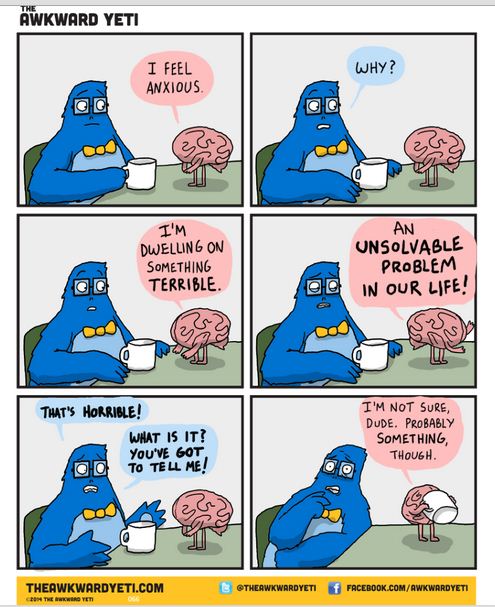
Yesterday, my husband showed me a comic that had me laughing my proverbial donkey off. Since I'm having another one of those days where I either don't feel like talking about my OCD or I don't have anything to say on the topic that is worth reading, I decided to do another roundup of things that don't suck. This time, it's going to be comics, but you read the title, so you know that already.

This is the comic that inspired this post. It reminded me of what I do for most of the day trying to stay ahead of and distracted from my anxiety. Yeah, it's not about mental illness specifically, but it speaks to it. 

My anxiety pukes on me too, comic strip writer.


I think uncontrollable shaking and nausea would be very helpful in a life or death situation. 


Sometimes, it is just like this. 

You can't negotiate with mental illnesses. 
(Comic from Hyperbole and a Half)


That's how I've lost 25 pounds in the past three months.
(Comic from Mania, Madness and Markers)


Feel free to share your favorite comics in the comments section below.


Sunday, December 27, 2015

Talking About Treatment With a Mentally Ill Person

Check out this old school depiction of
hypnotherapy. People suggest hypnotism and acupuncture
all the time. *sigh*
Getting treatment, in my experience, is one of the most important things a person can do in response to mental illness. It can really be a life changer. While a healthy support network of family and friends is typically part of that treatment, there is a line between mental health treatment and mental health support. In other words, loved ones are not medical professionals and vice versa. Therefore, loved ones should try not to give medical advice or make statements about medical treatment that can hinder progress.

Let me first say that I am not for coddling the mentally ill. In my case, coddling would actually be counterproductive. That said, leaving the medical stuff to the professionals is not coddling. Anything a non-professional has to say on the topic is opinion or conjecture and can be detrimental to mental health treatment.

Here are some examples of things I have personally heard people say to others with mental illnesses:

1. "*Gasp* You're on buspirone? I hated that." - to an anxious woman with medication fears.
2. "I hated Celexa. It made me almost kill myself." - to a man with OCD who was trying a new medication.
3. "I just want to see you start taking some responsibility for your actions." - to a man who had tried to kill himself just a few days before.
4. "I don't believe in therapy." - to a woman seeking therapy for her OCD.
5. "You'll become an addict." - in response to an anxious man taking an Ativan for a panic attack.

One thing that all of the above statements have in common is that they project some greater knowledge of mental illness while displaying a clear lack of understanding. Firstly, medications work differently for many patients. Telling someone who is desperately trying to get rid of suicidal thoughts that the medication they are on made you suicidal is not helpful. Gasping like a soap opera actress when someone tells you what medication they are on is also not helpful, especially if that person already told you to stop talking about medication. Looking down on therapy or suggesting that someone take responsibility rather than get treatment is also pretty unhelpful.

The takeaway here is that the amount of, and which, medications a person is on is between her and her prescriber. Whether sucking it up, taking responsibility or any other such platitudinous approach will help is between her and her therapist. If you care about your mentally ill friend or loved one, just hang out, be there like you normally would. Encourage them to talk to professionals and try to remember you are not a psychiatrist, mental illnesses are real and therapists aren't unicorns.